
Clover in grass swards
February 2026
Clovers are affected by soil pH and require the same pH range as grass (6.0 to 6.5). At low soil pH, clovers may not nodulate effectively and their ability to fix nitrogen is reduced; at very low pH levels, clovers may fail to nodulate completely.
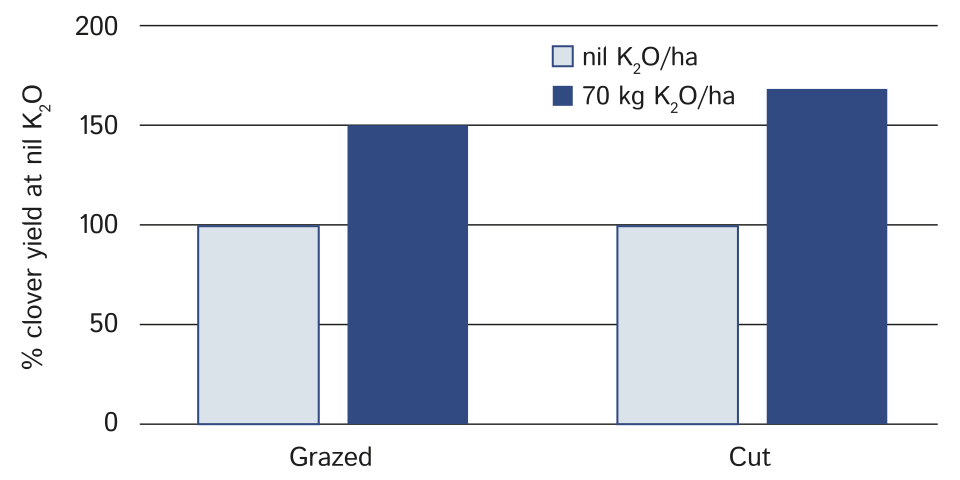
Potash is important for keeping a good proportion of clover in a sward. A good mixed grass/clover sward needs more potash than does grass alone. Field experiments over three years where herbage was either cut and removed or grazed showed the effect of applied potash on clover yields. Where 70 kg K2O/ha was applied each year, clover dry-matter yield was increased by 53% on the grazed sward and by 72% where the herbage was cut.
Clover, a key constituent of herbal ley mixes, can require significant amounts of phosphate due to the role this nutrient plays in root development, nutrient uptake and growth. Furthermore, as phosphate is a vital component of the ‘energy compounds’ within a plant; and as the fixation of atmospheric nitrogen is an energy hungry process; its efficiency is heavily reliant on plants having access to sufficient levels of phosphate.
The table below shows the effect of both phosphate and the equally essential sulphur fertiliser application rates on the yield of clover. This shows an increasing trend in yield from applications of each individually and both nutrients together.
Effects of rates of S and P fertilisers on clover DM production (t/ha)
| P2O5 (kg/ha) | SO3 (kg/ha) | |||||
|---|---|---|---|---|---|---|
| 0 | 28 | 56 | 112.5 | 225 | Mean | |
| 0 | 2.70 | 4.81 | 5.54 | 5.51 | 5.77 | 4.89 |
| 45 | 3.62 | 5.24 | 7.29 | 7.21 | 7.66 | 6.20 |
| 90 | 4.26 | 6.73 | 7.95 | 8.43 | 8.16 | 7.10 |
| 180 | 3.54 | 6.30 | 8.02 | 8.71 | 11.18 | 7.57 |
| Mean | 3.77 | 5.97 | 7.57 | 8.02 | 8.67 | 6.60 |
Potash is very important in the microbiological fixation of nitrogen by root nodules in legumes, therefore is also an important nutrient for herbal leys, especially those which contain a large proportion of legumes.
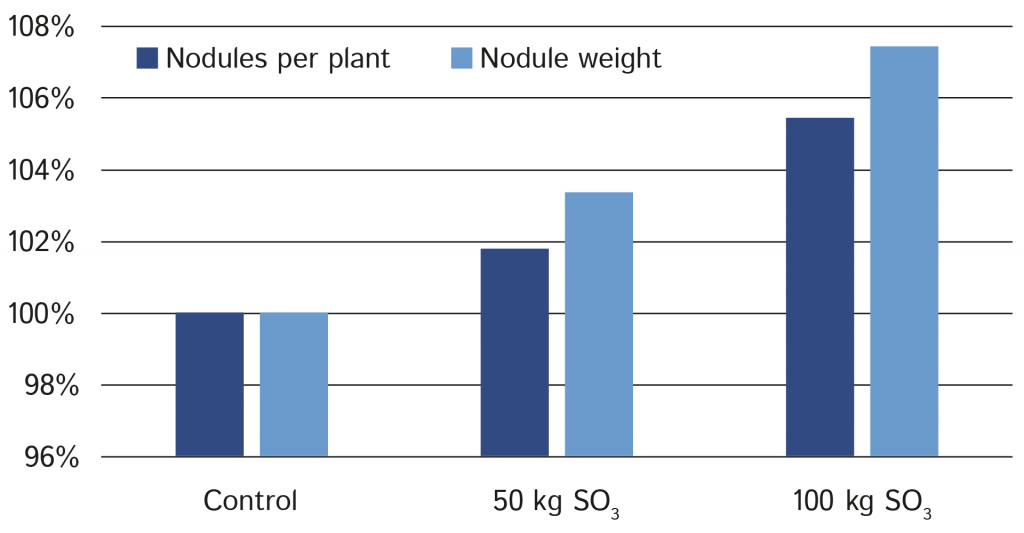
Clover, along with all legumes, also has a higher requirement for sulphur than grass. Sulphur supply is linked to nitrogen fixation and deficiency results in reduced nodulation, inhibition of nitrogen fixation, and a slowing down of nodule metabolism. The graph below shows the impact of increasing rates of sulphur on both the amount of nodules per plant and the weight of each nodule, showing a benefit in both incidences to increasing rates of sulphur.