

Download pdf: Nutrient Considerations for Potatoes (2.70M)
pdf 2.70M
Nutrient Considerations for Potatoes
March 2026
Phosphate, potash and sulphur are very important nutrients for potatoes affecting yield, quality and profitability. This newsletter is taken from the recently updated Potato leaflet, looking at earlier and new information available on this topic. Along with the leaflet, it provides guidance on best practice where crops are being produced for different markets, for different anticipated yields and where the crop is grown on different soil types.
Nutrient uptake and removal
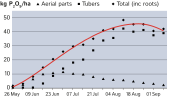
Due to the responsive nature of potatoes to phosphate, the restricted root system of the crop and the low mobility of the nutrient in soil, phosphate recommendations are significantly greater than crop offtakes. Appropriate phosphate fertilisation for the potato crop is likely to leave surplus soil phosphate levels for the following crops.
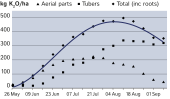
Potatoes take up more potassium than many other arable crops. In the six weeks after plant emergence, the crop will take in at least two thirds of the total K uptake. During peak vegetative growth, potatoes may require 10 kg K2O/ha per day from the soil solution, i.e. to be released from exchange sites. Maincrop potatoes contain the maximum quantity of potash in late July – early August and this may be more than 500 kg K2O/ha for high yielding crops. As the tops die back and the plant matures, some potash is returned to the soil. By harvest more than 75% of the maximum K uptake is found in the tubers, which typically contain around 5.8 kg K2O per tonne of tubers. For the determination of nutrient removal this figure is assumed to be constant over the normal yield range. From the potash offtake figure it is possible to calculate the maximum K uptake by the crop.
For example, a crop yielding 40 t/ha will remove 40 × 5.8 = approximately 230 kg K2O/ha but this is only about 75% of the maximum supply needed, which would be over 300 kg K2O/ha (230/0.75 = 306)1. A crop yielding 70 t/ha will remove 70 × 5.8 = 406 kg/ha which will have needed a maximum available supply of over 540 kg/ha (406/0.75 = 541).
Varietal and husbandry improvements have resulted in a continual increase in potato yields – for second earlies and maincrops, yields have increased from around 20 t/ha in 1960 to approaching 50 t/ha in recent years. This has an important implication for potassium supply because it needs to match this increased level of production.
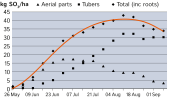
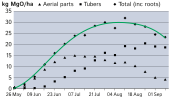
Pattern and distribution of nutrient uptake by potatoes
Available Supply
All soils contain large quantities of phosphate and potassium but only a small proportion of this is available for crop uptake in a season. Potassium is held by the clay minerals and organic matter in soil and is not leached or lost in the same way as nitrate and sulphate.
On the lightest textured and shallow soils some potash may move down the profile from the topsoil to a greater depth than can be reached by the roots of shallow rooting crops. However, in the majority of soils if more K is applied than is removed in the harvested crop, the excess will simply increase the amount of soil K reserve for following crops.
If offtake is greater than the quantity applied, soil reserves will be depleted. Hence normal manuring policy is to identify the appropriate level of soil K for the individual soil type and calculate potash use to maintain it, primarily by replacing the quantity of K removed in the harvested crop.
Most crops take up nutrients mainly from the ploughed or cultivated depth of soil. Where crops root more deeply some nutrient may be taken up from supplies at greater depth. Potato root systems are far less extensive than those of crops such as winter cereals or sugar beet and the crop is less able to take up nutrient from the deeper soil horizons (see table below).
| Crop | Root length (in top 20 cm) km root per m2 topsoil |
|---|---|
| Winter wheat | 24.4 |
| Winter OSR | 19.4 |
| Spring barley | 8.4 |
| Potato | 3.8 |
| Total root lengths of different crops. Ref: Barraclough, Rothamsted | |
However, improved soil cultivation and de-stoned bed systems increase the potential soil volume available to the crop for nutrient and water uptake, although phosphate and potash mixed into the soil above the planted tubers will be less available. Medium and heavy soils may also release some potash from non-exchangeable reserves which are not measured by a normal soil analysis. However, the potato crop is commonly grown on lighter soils which do not retain large amounts of non-exchangeable K.
Potash may be taken in via the leaves from foliar applications of soluble K fertilisers but only a very small proportion of the large total K requirement can be supplied by this route and foliar application tends to need a more expensive source of K than for soil application. This is because it is necessary to use a very soluble K source and to avoid the risk of the salt effect scorching the leaves.
Effect of soil K residues
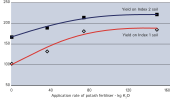
Relative yields from the trial shown above. Application of fresh potash fertiliser could not overcome the effect of the low K index soil
Potatoes need an amount of potash in the soil that can satisfy both the peak rate of demand during early vegetative growth and the total uptake in late summer. Where soil reserves are insufficient to meet either of these two requirements, the soil supply needs to be supplemented by adding K in fertiliser or manure. However, these additions may not be as efficient in providing K as the reserves in the soil. Long term experiments at Rothamsted and Woburn have shown that yields from impoverished soils are unlikely to match yields on fertile soils even if large amounts of K fertiliser are applied (see chart above). Also, it can take several years to improve a soil with a low K status once soil K reserves have been run down.
Calcium for potatoes
Calcium is a somewhat overlooked nutrient for arable crops, except perhaps for its role in soil structure and through its link with the liming properties of limestone. Potatoes are the one crop where the importance of calcium is better understood, through its impact on tuber quality. Calcium plays a role in the maintenance of healthy cell walls thereby reducing the incidence of the internal brown spots within tubers known as internal rust spot. The maintenance of healthy cell walls also helps to improve skin finish and protect against physical tuber damage at harvest and during storage. Another important role of calcium, again linked to cell wall strength, is the protection against pest and specifically disease as thinner, weaker cell walls are more likely to lead to attack from disease. There are reports of beneficial effects from the application of a non-liming source of calcium to potatoes.
Magnesium for potatoes
Magnesium is a key nutrient for all crops due to its role in photosynthesis, being part of the chlorophyll molecule. It is also involved in the production and use of carbohydrates, helping transport them from the leaves down to the tubers.
Deficiency symptoms are likely to develop in the older leaves nearer the base of the plant as the nutrient is mobile in plants and is therefore able to move to areas of new growth when uptake is limited. A deficiency of magnesium can reduce crop productivity long before visual symptoms can be seen. An inadequate supply will result in reduced root growth as well as lowering the chlorophyll concentration of the plant, reducing the photosynthetic rate.
Potassium : Magnesium imbalance
There is some evidence that potash availability and uptake can be reduced on soils where magnesium levels are excessive, even though the level of soil K may not be deficient. This situation is most frequently associated with long term use of magnesian limestone to correct pH. It is suggested that where the soil concentration of Mg is more than double that of soil K, potash applications may need to be increased above the normal recommended rate to achieve adequate potash nutrition of the crop.
- If 75% of the total crop uptake is in the tubers at harvest, the maximum uptake is 100÷75. ↩︎