
22. NK Arable Top Dressing (2.11M)
pdf 2.11M
22. NK Arable Top Dressing
Published April 2018
The general importance of potassium
Inadequate potassium supply to crops will result in serious penalties. Unfortunately low soil K cannot be “seen” and crop deficiency symptoms may not be identifiable as K shortage or not be evident until too late to remedy.
Penalties of low K
- Serious yield loss especially in adverse growing conditions eg dry summers.
- Weaker growth resulting in higher lodging risk.
- Lower crop vigour giving greater susceptibility to disease, pests and weed competition.
- Poor grain sample – low grain size, poor specific and 1000 grain weights, more tailings.
- Inefficient N uptake and utilisation leading to poor N response and less protein synthesis.
- Adverse effect on marketability.
- Lower tolerance to physiological stress – wet, drought, frost, wind.
Individually these effects may be slight but overall the result is lower crop value and higher costs per tonne.
Potash top dressing
Potash top dressing can be a useful strategy for a number of practical and technical reasons, particularly for winter cereals and oilseed rape.
1 Timing of nutrient uptake
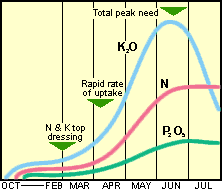 Only modest supplies of nutrient are needed for establishment and overwintering. Uptake then rises during vegetative growth in spring and is particularly large for potash with levels peaking in the plant around flowering and then declining as older leaves are lost and as the plant matures towards harvest. Peak uptake of potash by high yielding cereals is around 250 kg/ha; for oilseed rape crops it is 250-300 kg/ha. Field trials have indicated that as a generalisation potash supply will be adequate from soils at index 2. Soils at the lower end of this index contain 120 mg/l of available K which is equivalent to 145 kg/ha of K2O in the top 10 cm. This obviously falls well short of the total needed by high yielding crops and has to be supplemented by potash from greater depth and on heavier soils also from release of non-exchangeable soil K. On lighter shallower soils it may not be practical to raise soil K to this target level and soil supplies may thus not be adequate to fulfil the total need. The lower the level of soil K, the greater is the need for fertiliser supplementation. Potash top dressing has an obvious place in such circumstances.
2 Rate of uptake
Apart from the total peak requirement the rate of crop demand for potash is also important and may be as high as 5 or even 10 kg/ha/day for cereals and oilseed rape during the period of rapid growth. Low K soils and particularly lighter soils may not be able to supply potash at these rates. Provision of extra potash ahead of this period by top dressing obviously helps to fill this need.
3 Potash offtake
Potash removal is often under-estimated as crop yields increase and straw is frequently removed, A typical 8.5 t/ha crop of winter wheat with straw baled removes 100 kg/ha of potash.
Standard figures for K2O removal are:
| kg/t grain | |
| CEREALS | |
| Grain only | |
| All cereals | 5.6 |
| Grain + Straw | |
| Winter wheat & barley | 10.4 |
| Spring wheat & barley | 11.8 |
| Winter & spring oats | 16.7 |
| OILSEED RAPE | |
| Seed only | 11.0 |
| Seed + Straw | 17.5 |
4 Low soil K
Around 30% of all arable soils are below the target level of index 2 (PAAG results). This is often the result of management rather than of the inherent fertility and results from the under-estimation of removal referred to above.
Low potash is most likely on lighter soils and fertiliser applications need to provide more than is expected to be removed in the crop so that the extra helps to improve soil reserves. It is more practical to split the larger amounts required between basal applications and top dressing.
5 Potash leaching
Small quantities of K (1-10 kg/ha) naturally occur in drainage from most soils but fertiliser potash loss by leaching is not significant from most arable soils. Only the K in soil solution is at risk of being lost from top soils and even then it may be held in sub-soil, depending upon clay content, from where deeper roots will retrieve it. Light shallow soils with low clay content (under 5%), especially under conditions of high and irregular rainfall, are most susceptible to leaching. Such soils are often naturally deficient in K and have greater fertiliser potash requirement. Potash is best applied “little and often” on these soils and single large dressings should be avoided.
“On such soils it is better to apply both N & K together rather than at separate times”
extract from a paper by A E Johnston & K W T Goulding , Rothamsted Research
6 N & K partnership
High yielding crops need large supplies of both nitrogen and potash and it is no accident that the addition of N stimulates the need for and uptake of K. Nitrogen is mostly taken up as the negatively charged anion nitrate (NO3–) and to maintain neutrality the plant needs to take up equal amounts of a positively charged cation. Potassium as K+ is the preferred cation. Where K+ may be in short supply from the soil there is obvious benefit from top dressing with nitrogen plus potash.
Within the plant, synthesis of N to simple amino compounds and ultimately to protein depends upon an adequate supply of K thus providing further support for ensuring N and K supply by top dressing.
Full response to nitrogen will thus not be obtained where potash is limiting and this will result in lower yields and poorer crop performance.
7 P & K balance
For the great majority of cereal crops, potash removal is considerably greater than that of phosphate and this should be reflected in fertiliser use. Potash top dressing offers a convenient way of maintaining the correct replacement balance in a number of cases:
- On light soils where soil P levels are satisfactory but K levels need to be improved:
Use basal PK to provide necessary phosphate (most beneficial at establishment) and some potash. Plus NK top dressing to make-up potash needs. - On soils of good phosphate and potash fertility:
Use NK top dressing to replace some of the potash removed. Omit phosphate altogether if soil index is sufficiently high. - On well established crops where no basal fertiliser was used because of weather etc:
Use NK top dressing for speed of work and to minimise number of different products. Make-good phosphate need in seedbed of following crop.
| Action | ||||||
 |
Identify the potash needs for each field according to soil analysis and expected removal. This can be calculated using the PDA Calculator which can be found on the PDA website. | |||||
|
Plan autumn seedbed fertiliser on basis of soil P and K levels, soil texture/depth and workload. | |||||
|
Top dress with N and K before the end of March for cereals and rape as necessary. | |||||
|
Apply 35-70 kg/ha potash depending upon the specific need. | |||||