13. Potash, Phosphate and Sulphur for Oilseed Rape (1.28M)
pdf 1.28M
13. Potash, Phosphate and Sulphur for Oilseed Rape
Published December 2021
Introduction
Oilseed rape has faced a few challenges in the UK recently, rapidly falling out of favour on-farm due to difficulties with establishment following the loss of neonicotinoid seed treatments in 2014. On top of this it has also faced increasing pest pressure throughout the growing season, increasing occurrences of Clubroot, Turnip Yellows Virus, erucic acid levels and weed control. However, despite all this, OSR remains one of the more important and economic break crops on many combinable farms when it can be grown successfully.
The risks involved in growing the crop have increased greatly, and the greatest risk period is the autumn around establishment. This is when the crop is most vulnerable to Cabbage Stem Flea Beetle (CSFB) and where it stands the greatest risk of failure. Improved establishment is key to the success of the crop, and the primary area of focus for this should be the soil. Soils should be well structured, at a neutral pH and soil indices should be at the target index of 2 for phosphate and 2- for potash.
Nutrient balance
Efficient crop nutrition requires the correct balance of all nutrients. This leaflet focusses particularly on the importance of potassium (K) because of its critical role in the efficient use of nitrogen (N), however it also covers the other major and secondary nutrients required for optimal oilseed growth.
Each year only about 44% of the oilseed rape crop receives a dressing of potash (K2O) fertiliser and if sufficient K is not available to the plant from the soil, yields will be reduced.
Functions of potash
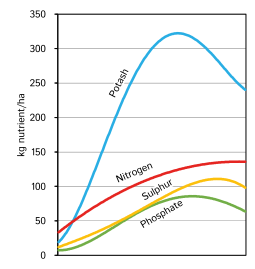
The functions of potash in the oilseed rape plant are not necessarily visible or obvious but this nutrient is nevertheless vital for vigorous, healthy crop growth and profitable yields. In fact, more potash needs to be taken up by the plant than any other nutrient including nitrogen (Figure 1), with the majority of it being required to create the osmotic potential in the cell sap, enabling the leaves to maintain their turgor. Without adequate potassium cell production and expansion is limited.
Potassium also plays a vital role in the transport of sugars and other products of photosynthesis from the leaves to other parts of the plant for growth, formation of seed and deposition of oil. It is vital in the water regulation of the plant and plays an important balancing role with nitrogen to ensure healthy, vigorous growth and natural resistance to disease, pests and stress.
Many of the functions of potash in the plant are related to physiological conditions and stress. These functions are diverse and include:
- efficient nitrogen and water use
- drought tolerance
- frost resistance
- resistance to pests and diseases
This last point is of particular importance in the current climate, with CSFB and aphids causing such devastation to oilseed rape crops. Although there is no evidence of potassium having an effect on CSFB feeding pressure, there is work that has shown a positive correlation between higher potassium levels and reduced aphid numbers (Table 1).
| Table 1. Impact of potassium on population build-up of aphid and crop yield in Brassica napus | ||
| Potassium treatment (kg/ha) | Aphid population/plant | Yield (t/ha) |
| Control | 13.70a | 2.56c |
| 60 | 8.46b | 3.02b |
| 80 | 7.63b | 3.12b |
| 100 | 4.63b | 3.50a |
| 120 | 4.30b | 3.56a |
| LSD | 4.6 | 0.30 |
| Ref: Sarwar, Muhammad & Ahmad, Nazir & Tofique, Muhammad. (2011) Journal of Zoology | ||
There are several processes by which potassium helps to reduce insect pest pressure:
- The leaf yellowing associated with potassium deficiency attracts aphids to plants
- High levels of potassium provides resistance against insect pests by enhancing secondary compound metabolism, reducing sugar accumulation and therefore plant damage.
- Sufficient potassium levels hardens plant cell walls, stimulates lignin production leading to thicker and harder stems. This is considered to improve mechanical resistance to feeding of insects, particularly sucking insects such as aphids.
Potassium deficiency
Deficiency symptoms are not commonly seen in the field but plants will suffer from potash limitation long before any visual effects on the leaf are apparent. General stress from drought, cold, water-logging, etc. will be aggravated if the plant is short of potassium and crops with better K supply will grow through such difficulties more satisfactorily. K deficiency can also be one reason for early lodging in crops.
Uptake of potash
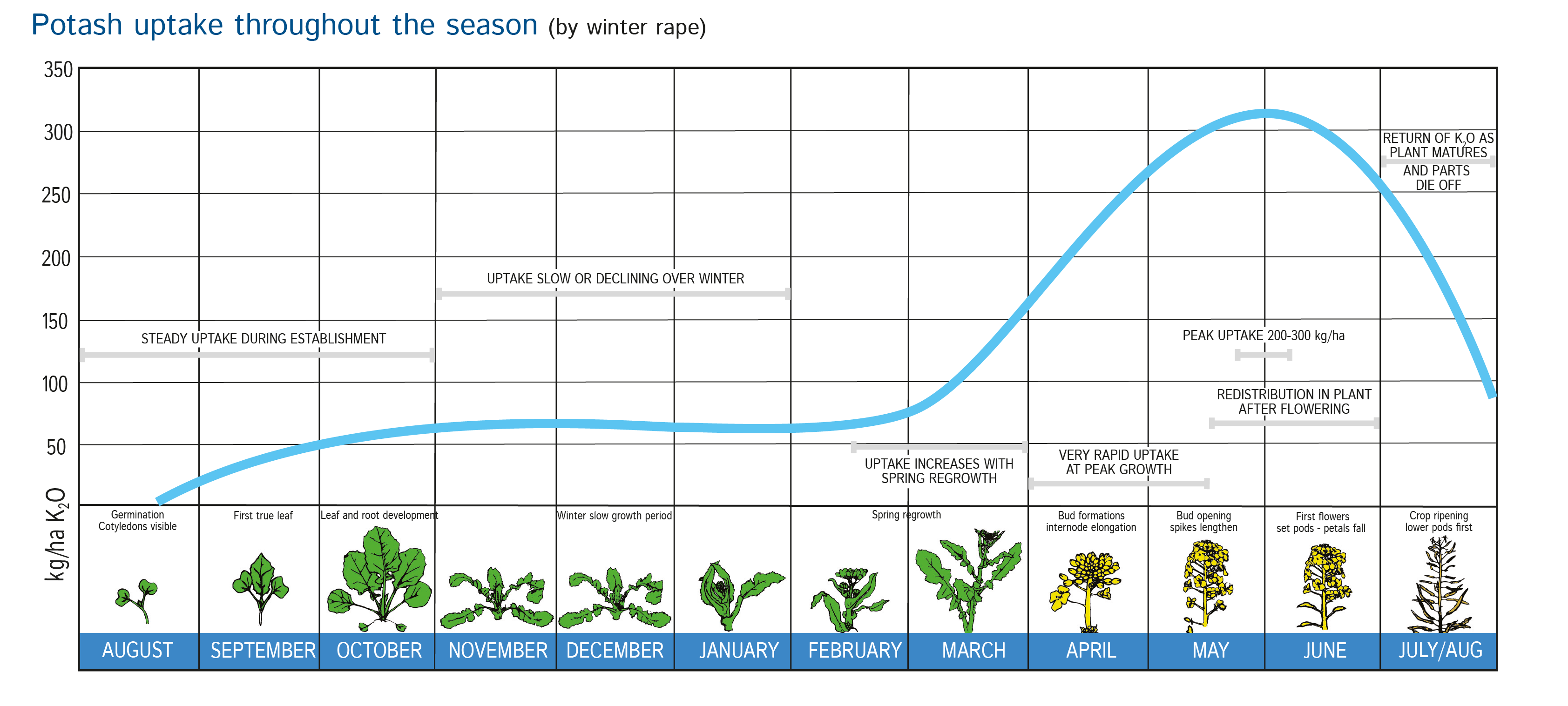
Potassium levels in the establishing plant are quite high at 3-4% and although the total bulk of the crop is fairly small, there will be around 60-75 kg/ha of potash (K2O) in the crop by the end of autumn. Some forward crops have been found with levels of over 100 kg/ha by November. Over winter potash content is stable or may fall with leaf loss from frost, pest and disease effects.
The rate of growth and uptake requirement of oilseed rape plants in the spring is dramatic. Potash demand may be in excess of 12 kg/ha/day. Where conditions for growth are not ideal (poor soil structure, thin soils, very wet or dry conditions etc.) the plant may not be able to extract its full needs even though the total quantity in the soil is theoretically sufficient. Continental fertiliser recommendations tend to be more generous than in the UK in order to ensure that the peak supply is adequate for optimum potential growth and yield; for example, the overall application rate of potash in Germany is 80 kg K2O/ha. As with cereals, a spring top-dressing with an NKS fertiliser will be worthwhile if the K available from soil reserves is insufficient (see leaflet 22: NK Arable Top Dressing).
Maximum uptake normally corresponds with the end of flowering when a crop will contain over 300 kg K2O/ha (Figure 2). Peak uptake levels of 440 kg/ha have been recorded with high yielding crops. After seed set, potash in seed and pod continues to increase whilst leaf and stem content falls.
Soil K fertility must be maintained at a level which does not restrict this large and rapid uptake. The recommended target soil index for oilseed rape for optimal yield is 2- (121‑180 mg K/litre).
Potash offtakes
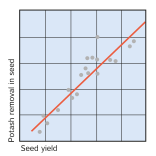
The yield of seed is closely related to the total dry matter production and because the % K between different healthy crops does not vary greatly it follows that total potash removal (offtake) is directly related to yield (Figure 3). Higher yielding crops take up more potash and where more nitrogen is used to achieve higher yields potash removal is increased.
The % K content of a healthy crop declines during growth from around 3-4% in the young plant to 2% at flowering. The seed itself contains only around 1-1.2% K. The amount of potash actually removed in the seed at harvest therefore represents only a very small proportion of the total potash which was in the growing crop.
Typically, 11 kg K2O/ha are removed for every tonne of seed harvested. However, the offtake rises to 17.5 kg K2O/ha per tonne of seed harvested if the rape straw is also removed from the field.
As a guide, a 4.0 t/ha winter oilseed rape crop harvested for seed only will remove approximately 45 kg K2O/ha (4 × 11 = 44). If the straw is also removed, the crop offtake increases to just over 70 kg K2O/ha (4 × 17.5 = 70).
Response to potash
Uptake and removal should not be confused with response. Whilst oilseed rape takes up large quantities of potash, UK trials have not often shown yield responses, probably due to the soil K supply being adequate. A response would be expected from the application of potash to K-deficient soils; indeed, a response to potash (or phosphate) fertiliser is likely to be indicative of a soil deficiency. However, little yield response work has been done in recent years with new higher-yielding varieties.
Whilst potash is known to improve oil content in a range of other crops, no relationship has been found in this country with oilseed rape field trials although pot experiments have shown an increase in oil content of winter oilseed rape with increasing rates of potash fertiliser.
Potash recommendations
Soil analysis is an essential management tool and regular soil sampling should be carried out every 3 to 5 years as a requirement of the 2018 Farming Rules for Water. Both the actual soil index as well as any changes should be considered.
Soil K fertility should be maintained at least at index 2- (121-180 mg K/litre). At this target index, sufficient potash should be applied to replace that removed in the harvested crop, i.e. the crop offtake. This is termed the maintenance (M) rate of application. General values can be used as shown in Table 2 opposite, or more appropriately the maintenance application rate can be calculated from the known yield and offtake.
Where soil K index levels are below 2-, a ‘build up’ policy should be followed to raise low fertility soils back to the target index. The general recommendation is to increase the potash application rate, over and above the maintenance dressing, by 60 and 30 kg K2O/ha for soil K index 0 and 1 respectively. However, it is important for yield and crop quality that a deficiency of K in the soil is corrected with as little delay as possible and larger dressings will be more effective. Guidance on building soil reserves is available from the PDA Calculator. It will be more appropriate to consider the cost of such ‘build-up’ dressings as a ‘capital’ improvement rather than as a variable cost set against the crop. Where the soil index is well above the target index of 2- reductions in rates of application are possible.
| Table 2. RB209 potash recommendations for OSR | |||||
| K Index | 0 | 1 | 2- | 2+ | 3 and above |
| Winter oilseed rape (3.5t/ha) (kg K2O/ha) | 100 | 70 | 40(M) | 20 | 0 |
| Spring oilseed rape (2t/ha) (kg K2O/ha) | 80 | 50 | 20(M) | 0 | 0 |
Time of application
Where soil reserves are satisfactory, e.g. index 2 or more timing of potash application is not critical. For soils of K index 0 and 1, potash is best applied in the seedbed. Early spring top dressing with potash are likely to be beneficial where availability of K for peak spring growth is limiting, on light soils where some leaching of K over-winter is possible, or where other management or buying advantages are obtained.
Phosphate
Phosphate is a component of several essential cell components and specifically helps to promote root development and early flowering and ripening. Its role in root development is important for establishment, leading to a focus on early applications. Phosphate plays a role in the energy storage and transfer within a plant, and is therefore important in the production of oil in oilseed rape.
A deficiency of phosphate can reduce both the above and below ground biomass, with a reduction in rooting having knock-on implications for the uptake of other nutrients from the soil. Although the nutrient is relatively immobile in soil, it is mobile within the plant, meaning deficiency symptoms show up on older leaves first. Symptoms appear as a reddish discolouration of leaves, due to a build up of anthocyanins in leaves. For this reason, phosphate deficiency during the colder months can be difficult to identify in the field, as anthocyanins tend to be related to an increase in stress, which may be due to a number of reasons.
Sulphur
Oil crops have the greatest requirement for sulphur compared with most other crops due to the requirement for glucosinolate production in the crop (although recent breeding has lowered the levels in the seeds) and the nutrient’s role in oil synthesis. Sulphur is also required by plants for vegetative growth and is a component of plant amino acids, proteins and enzymes. Due to being an essential component of proteins, it has a direct relationship with nitrogen and adequate sulphur is required to achieve good nitrogen use efficiency (NUE).
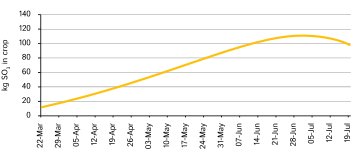
Oilseed rape has a high demand for sulphur (Figure 4) and is particularly sensitive to sulphur deficiency compared to other crops. Visual symptoms of deficiency include yellowing of the older leaves, and later during flowering, shows up as a change in shape and colour of the petals. Severe deficiency can result in reduced growth of the plant and a reduction in both yield and quality of up to 40%.
Sulphur applied to oilseed crops in the autumn improves the retention of a range of other nutrients, including capturing soil nitrogen reserves. It also helps to reduce senescence of lower leaves over winter.