
12. Potash for sugar beet (2.46M)
pdf 2.46M
12. Potash for sugar beet
Published March 2022
Introduction – BBRO
Sugar beet is an increasingly important crop in the rotation, providing an essential break to weed, pest & disease cycles. This is of increasing importance as we reduce reliance on pesticides and transition to more integrated control approaches. Improving soil health and crop nutrition are the foundation to this approach, delivering more inherent resilience in crops. Ensuring adequate nutrition to drive rapid early canopy growth is one key focus area, especially for improving mature plant resistance to virus and early light interception. Additionally, and as recent BBRO data has highlighted, another key focus area is the importance of soil health and crop nutrition in improving drought tolerance. On average, sugar beet crops lose 10% of their potential yield to drought every year and crop nutrition has an important role.
Potash and sugar beet
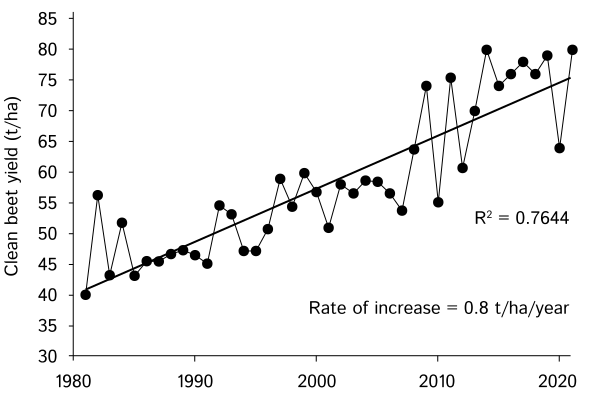
During the last four decades, yields of clean beet and sugar in the UK have been increasing linearly, at an average annual rate of 0.8 t/ha of clean beet. The five-year average yield has increased from approximately 45 t/ha in the early 1980s up to 80 t/ha more recently. The devastating impact of virus yellows in 2020 following the loss of noenicitinoid seed treatments reduced the yield in this year to just over 60 t/ha.
This rapid increase in yield raises the question of whether the currently recommended amounts of potash are adequate to achieve this target, especially as the recommendations are largely based on results of experiments that are 40-50 years old. In this revised leaflet, data from more recent experiments has been used, in which yields exceeding 70 t/ha adjusted beet were obtained, to re-examine the recommendations for potash.
Potassium is essential
Potassium (K, usually referred to as potash: K2O) is an essential nutrient for all living organisms. For sugar beet, adequate amounts of K must be available in the soil for the uptake by roots to enable crops to achieve large yields of acceptable quality. Potassium also enhances the ability of plants to resist stress from diseases, pests, cold and drought. Potassium performs these roles in all crops, so it is important to ensure adequate K for all crops grown on the farm.
It is well established that plant-available reserves of potassium and phosphorus (P, phosphate: P2O5) can accumulate in most UK soils. Applications of both fertilisers and organic manures containing P and K contribute to these reserves. Maintaining an appropriate level of plant-available P and K in the top-soil is important because it ensures that growing roots can access sufficient P and K to meet the changing needs of a crop during the growing season. These reserves can be estimated by soil analysis and a soil can be assigned to a P and K Index, as in the AHDB Fertiliser Manual. The Index relates to the soil and not to the crop. Its value indicates the level of plant-available K in the topsoil with the number increasing as the level of plant-available nutrient increases (see leaflet 24 Soil Analysis).
The needs of sugar beet for potash and its responses to this nutrient are summarised on the next page. Each of these points is discussed in more detail in the following sections while the roles of phosphate, magnesium, sulphur and sodium in plants are addressed at the end of the leaflet.
Some of the data used here are from six years of trials on two sites which have soils with a wide range of long-established K Index values within a single field. One is on the silty clay loam at Rothamsted, the other on the sandy loam at Woburn. The aim was to check whether modern high-yielding varieties of sugar beet require more K to achieve maximum yields of beet and sugar. The experiments were funded by the British Beet Research Organisation (BBRO) and carried out by British Sugar plc and Rothamsted Research.
Summary
- Potassium (K, potash: K2O) is essential for all crops and sugar beet requires large amounts.
- Soils should be maintained above the critical level for plant-available K, P and Mg to achieve optimum yields and quality of all the crops grown on the farm.
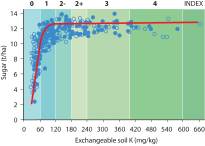
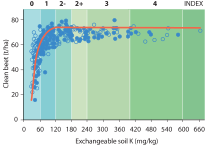
- For sugar beet, the critical level for potash is K Index 2-. Below this level, yield will be lost. Yields are not increased when soils are at K Index 3 and above.
- Crops need K where the roots can get it, i.e. throughout the soil explored by the roots. Sugar beet only very occasionally responds to freshly applied potash, and then only on soils with very low levels of available K (K Index 0). It is wise to regard applications of potash as part of the longer-term strategy to raise or maintain soil K at a suitable level rather than as a means of immediately increasing beet yields or correcting deficiency.
- Potassium in the ploughed-in tops is returned to the soil K reserve.
- To maintain adequate levels of soil K, the K removed in the harvested beet needs to be replaced on all soils below K Index 3. The quantity removed can be seen for individual contracts from British Sugar On-line.
- Sugar beet has a sodium (Na) requirement and in addition, sodium can substitute for some of the functions of potash; applying Na will be of benefit on K Index 0 and 1 soils and on soils low in available sodium.
REMEMBER: Once soil K has been adjusted to above the critical level it needs to be maintained at that level because at lower levels yield loss cannot be corrected immediately by fresh potash. This maintenance can be achieved by estimating the amount likely to be removed in the harvested beet before the sugar beet is sown or replacing the amount removed before the next crop is sown. Either way, the actual K status of the soil needs to be checked by soil sampling and analysis every 4-5 years.
Potash and the yields of beet and sugar
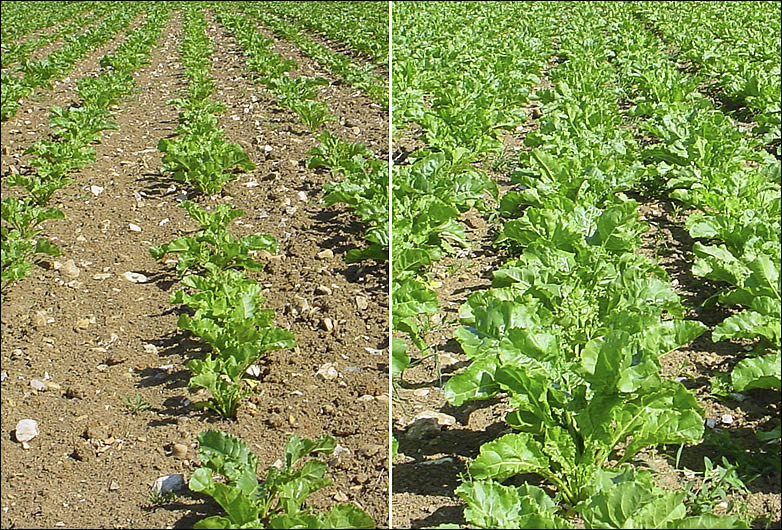
In experiments carried out at Rothamsted and Woburn, yields of clean beet and sugar increased as the availability of soil K (K Index) increased. Maximum sugar yield was achieved on plots which were at K Index 2- or above in all six years, both on the silty clay and the sandy loam soil. Sugar yields were greatly decreased when the K Index was below this critical value because the lack of plant available K decreased both the yield of clean beet and the sugar content (% sugar).
The responses of sugar beet to soil K (K Index) in these experiments are very similar to those from experiments done in the 1970s. They show that despite improvements in breeding and an increase in yield achieved since the experiments in the 1970s, the recommendations on K fertiliser for higher-yielding sugar beet crops had not significantly changed.
In these experiments, as well as British Sugar’s more extensive trials on soils of widely ranging K Index, there were no yield responses to freshly-applied fertiliser K at any level of soil K, even on low Index soils on which responses might have been expected. In part this is because it is difficult to mix freshly applied K evenly into the top soil by cultivation and possibly due to contributions from sub-soil K, especially on light soils.
Potassium uptake and removal from the field
Potassium uptake
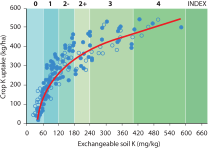
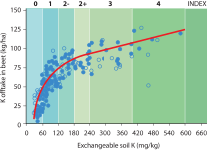
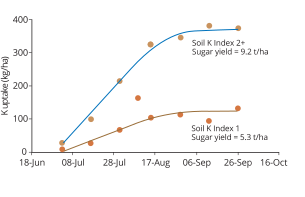
Sugar beet has a large requirement for K. Chart 3 shows the total crop uptake and offtake of K in the harvested beet of the crops whose yields are shown in Chart 2, whilst Chart 4 shows the total uptake along with the split between the roots and the tops from a separate trial series. Where maximum yields were achieved at soil K Index 2- (i.e. 120-180 mg K/litre) the corresponding uptake into the crop was up to 480 kg K2O/ha of which 90-100 kg K2O/ha was in the harvested beet and therefore removed from the field. On soils with plentiful K, the uptakes and offtakes of K can be much larger than this optimal requirement (i.e. up to 600 kg/ha in the crop and 150 kg K2O/ha removed, respectively). Extra K in the roots, however, does not increase clean beet or sugar yields; it serves only to decrease beet quality.
Potassium offtake (removal from the field)
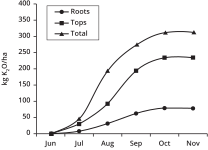
Much of the K needed by the crop is taken up during the early months of growth (Chart 5). However, more than 70% of it remains in the tops at harvest, and will be returned to the soil if the tops are subsequently ploughed in. Although the amount of K removed in harvested beet is considerably less than in the tops (90-100 kg K2O/ha), it still has to be replaced to maintain the soil at an appropriate K Index.
Therefore, fertiliser policy should be based on the long-term aim of achieving and maintaining the soil at least at K Index 2-. For soils at Index 2- (120-180 mg K/litre) and 2+ (180-240 mg K/litre) only maintenance dressings need be applied to replace the K removed in the beet. Where soils are at Index 0 or 1, extra K needs to be applied in addition to the maintenance dressing to build up soil reserves. On light textured soils, such as sands, that have a lesser ability to hold onto K than clay soils, it will need to be applied for each crop in the rotation. On soils of K Index 3 and above, no maintenance or build-up dressings of K need be applied. The PDA Calculator can help to plan application rates to aid build up soil reserves over a set time period depending on soil type.
In the past the quantity of K removed in the harvested beet, which is needed to calculate the maintenance dressing (M), had to be estimated approximately, from the guideline that each tonne of beet harvested from the field contains 1.7 kg K2O. The British Sugar On-line calculator provides information on how much K2O is present in beet delivered to the factory. The calculation normally relates to the contract as a whole but can be related to specific fields if growers schedule their deliveries on a field by field basis. This is a unique service for sugar beet growers which helps them ensure that the correct amounts of potash are returned to each field.
Fertiliser recommendations for phosphate, potash, magnesium and sodium
BBRO’s Growers Guide and the AHDB Fertiliser Manual give the same recommendations for potash and magnesium applications, both of which are related to soil Index. The maintenance dressings (M) for K at soil Index 2- in those publications relates to replacement of offtake at a yield of 60 t/ha:
| Recommendations | Soil K or Mg Index | ||||||
| 0 | 1 | 2- | 3 | 4 | 5 | ||
| Phosphate | kg P2O5/ha: | 110 | 80 | 50M* | 0 | 0 | 0 |
| Potash | kg K2O/ha: | 150 | 125 | 100M* | 0 | 0 | 0 |
| Magnesium | kg MgO/ha: | 150 | 75 | 0 | 0 | 0 | 0 |
* This is a general estimate for the maintenance dressing. As indicated above, individual growers can obtain more accurate offtakes from British Sugar On-line. Where yields are above 60 t/ha, offtakes will be greater by about 1.7 kg K2O for each extra tonne of yield.
The BBRO Growers Guide and the AHDB Fertiliser Manual also give the following recommendations for sodium:
| Recommendation | Available sodium (Na) in soil, mg/litre | |||
| Less than 20 | 20 – 40 | Over 40 | ||
| Sodium | kg Na2O/ha: | 200 | 100 | 0 |
Timing of applications
For soils at K Index 2- there are several potential benefits to be gained by applying the necessary nutrients in the late autumn and early winter prior to ploughing the land destined for the beet crop. Sugar beet has active roots at depth, but the main advantage of such early spreading is that the absence of newly applied nutrients in the seedbed is helpful to germination and the establishment of a good plant population. The fact that there will be no wheel-marks in the seedbed from the spreading and incorporation of these nutrients is another significant benefit.
However, growers on light-textured sandy soils with low clay content should be aware that it may be difficult to raise a low soil K Index even up to Index 2-. In this situation it is better to apply the appropriate amount K for the crop in the early spring after ploughing and for this K to be well incorporated by cultivation. It is not recommended to apply large ‘rotational manuring’ dressings of K to these soils.
Use of sodium (salt)
Sugar beet has a specific requirement for sodium (Na) in addition to K, for growth. The crop usually takes up about 70 kg Na2O/ha on a soil well supplied with K, an amount much less than that of K. Most of the Na is retained in the tops where it is mainly used to sustain the growth of the leaf canopy. On soils very low in K (Index 0-1), Na can replace K in its role of maintaining cell turgor. Sodium is usually applied as agricultural salt, Sylvinite or Kainit, the latter two supplying both K and Na and some Mg. Soils located close to the sea can contain Na deposited in rainfall.
It has been thought by some that adding salt to soil might damage soil structure, a view which stems from seeing the adverse effects on soil following prolonged flooding with seawater. There is no evidence that where salt is applied to soils at the appropriate recommended rate, it has any adverse effect, even on soils with little structural stability.
Sources of potassium, sodium, magnesium and sulphur
These four plant nutrients are available in a number of sources from which they are readily available for uptake by plant roots, especially from the inorganic materials.
| Material | Nutrient | |||||
| K2O | Na2O | MgO | SO3 | |||
| Inorganic sources: | concentration (%) | |||||
| Muriate of potash (KCl) | 60 | – | – | – | ||
| Sulphate of potash (K2SO4) | 50 | – | – | 45 | ||
| Polyhalite (Polysulphate) | 14 | – | 6 | 48 | ||
| Nitrate of soda (NaNO3, 16% N) | – | 36 | – | – | ||
| Sylvinite* | 16-21 | 26-34 | 1.5 | – | ||
| Kainit* | 11-13 | 20-30 | 5-6 | 9 | ||
| Kieserite | – | – | 26 | 50 | ||
| Calcined magnesite | – | – | 80 | – | ||
| Organic sources:** | kg/t fresh weight (‰) | |||||
| Cattle FYM (25% DM) | 8 | – | 0.7 | – | ||
| Pig FYM (25% DM) | 5 | – | 0.7 | – | ||
| Layer manure (30% DM) | 9 | – | 2.2 | – | ||
| Broiler/turkey litter (60% DM) | 18 | – | 4.2 | – | ||
| * The content varies slightly in these naturally occurring materials. ** For more details see the AHDB Fertiliser Manual. Where organic manures are applied to soils at K Index 2- and above, the amount of K applied in the manure should be deducted from the recommended amount of fertiliser K. For soils at K Index 0 and 1, the additional manure K will help to increase soil K reserves and thus improve soil fertility. |
||||||
Approximate conversion factors:
| K2O to K | Multiply by 0.83 | |
| Na2O to Na | Multiply by 0.74 | |
| MgO to Mg | Multiply by 0.60 | |
| SO3 to S | Multiply by 2.5 |
Role of potassium
Potassium has several roles in plants. It is essential for the activation of some enzymes within the cell. Only a small proportion of the total K in plants is required for this, perhaps 20% in cereals for example, but in these roles it cannot be replaced by any other element. Much more K is required to fulfil other major functions in plants. In these roles the plant prefers to use K rather than other elements like sodium and calcium. For this reason, the plant must have a sufficient supply of K available to it because it will take up large quantities of K daily from the soil during growth.
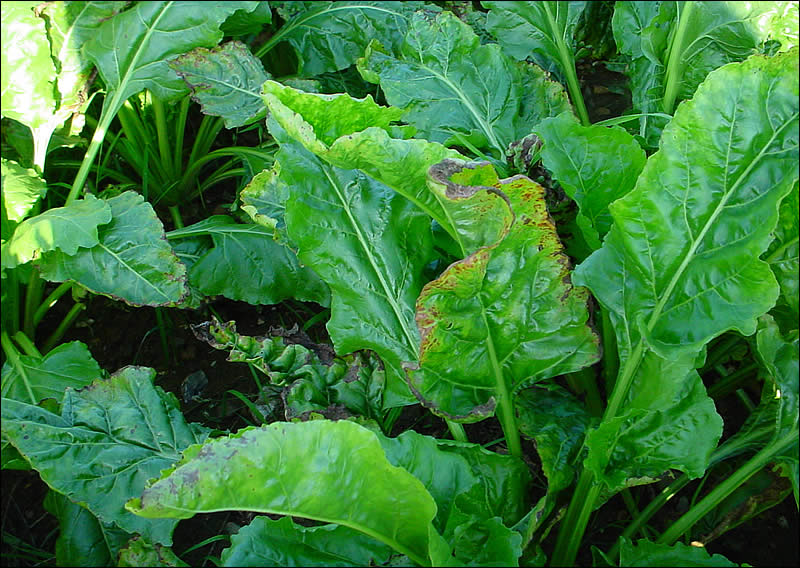
Potassium is essential for growth and is the main element used to maintain cell turgor (rigidity) and to regulate the water content of the plant. Potassium is also involved in controlling the opening and closing of the stomata (the openings in leaves through which water is lost by transpiration and carbon dioxide enters the leaf to be converted to plant dry matter and sugar).
The importance of cell turgor cannot be over-emphasised. For maximum sugar yield it is essential to optimise the interception of solar radiation (sunlight) to provide the energy for the conversion of carbon dioxide to sugars. This requires a rapidly expanding leaf canopy. Nitrogen (N) supply drives the rapid production and expansion of cells. These rapidly expanding cells require K to obtain water and maintain their turgor with tissue water having a high potassium content. Green plants often contain more K than N.
Potassium also has another equally important role in the transfer of sugars produced in the leaves to the storage root. In its passage from leaf to storage root each molecule of sugar has to pass through innumerable cell membranes, and K+ ions are an essential component of the ‘molecular pump’ within the cell membranes that facilitate this passage.
Role of phosphate
Much of the phosphate found in the sugar beet plant is in the inorganic form and has many roles in cell metabolism, particularly as a source of energy. The cell processes in which it is involved include photosynthesis, respiration, biosynthesis, stomatal opening, and the transfer of organic solutes across membranes. Phosphate deficiency has been shown to reduce photosynthesis, protein synthesis, increase carbohydrate content and decrease moisture content. The table below shows the total uptake of phosphate by sugar beet at harvest and the split between roots and tops.
| Uptake (kg P2O5/ha) | ||
| Roots | Tops | Total |
| 45 | 35 | 80 |
| Ref: Draycott & Christenson, 2003 | ||
There are conflicting reports on the effect of phosphate fertiliser on sugar beet quality, however it usually has a positive effect on sugar percentage, particularly where soil indices are low. On soils that are at or above the target index, improvements in sugar percentage are unlikely from phosphate applications.
At times of high fertiliser prices it can be tempting to look at ways of reducing inputs, particularly phosphate and potash, when soils are at higher indices. However, caution is required to ensure that short term decisions are not taken that result in the run down of soil indices. With phosphate in particular, small amounts of nutrient, especially at low indices can help ensure phosphate availability to young establishing plants, which could be especially important in challenging seedbeds and cool weather conditions.
Role of sulphur
In sugar beet, sulphur is essential for protein synthesis to maintain the balance of amino and sulphur-containing compounds within the plant. The uptake of sulphur by sugar beet is around 50-70 kg SO3/ha in average yielding beet crops and as much as 100 kg/ha in higher yielding crops. An imbalance of nitrogen and sulphur, caused by sulphur deficiency can result in amino nitrogen accumulation within the plant, leading to lower quality and reduced root storage capacity.
Work on other arable crops such as OSR and cereals has shown that crops frequently respond to additional sulphur fertilisers, especially on lighter land where the risk of sulphur deficiency is greatest. The depletion of atmospheric deposition of sulphur is well documented. Previous trials have identified small but often inconsistent response of sugar beet to additional soil-applied sulphur. BBRO’s current series of trials is assessing sugar beet responses on low sulphur sites to additions of 25, 50, 75 & 100 kg SO3/ha. BBRO trial results in 2017 showed a limited number of statistically significant yield response to any addition of sulphur, whilst there were no symptoms of sulphur deficiency identified in the canopy of untreated plots.
BBRO’s conclusion for the trials so far suggest that 40-60 kg SO3/ha is sufficient for sugar beet crops, using the higher rate where yields are expected to be >80 t/ha.
Role of magnesium
Magnesium is an essential constituent of chlorophyll, which gives leaves their green colour. Chlorophyll is involved in the conversion of carbon dioxide to sugars and Mg also has a role in protein synthesis. Soils at Mg Index 2 and above usually contain sufficient plant-available Mg to meet the needs of the crop. On soils of Mg Index 0 and 1, Mg should be applied. When adequately supplied with Mg there is about twice as much in the tops as in the roots, so most of the Mg taken up by the crop is returned to the soil when tops are ploughed in.
Role of sodium
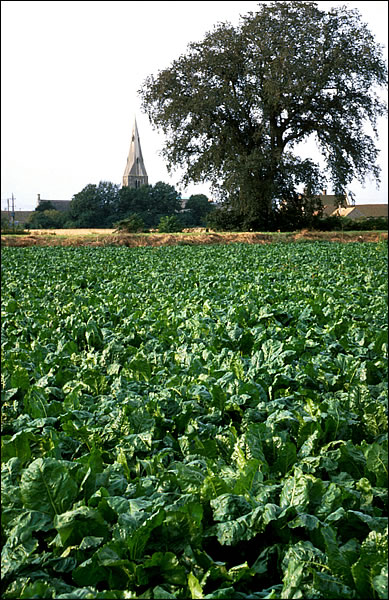
The other role of sodium (Na; common salt is sodium chloride, NaCl) in sugar beet nutrition is interesting. At one time it was thought that K and Na were totally interchangeable in their functions in the nutrition of beet, but further work has shown that this is not entirely correct and that there are important differences. Sugar beet has a specific, irreplaceable requirement for Na and usually takes up about 70 kg Na2O/ha on a soil well supplied with K. Most of this Na is retained in the tops where it is used mainly to sustain leaf growth and canopy development. A rapidly expanding leaf canopy is essential to intercept incoming radiation effectively and to drive sugar production.
The role for sodium in beet relates to it being descended from wild beet that grew in maritime environments where there were large amounts of Na and little K. In this environment the plant adapted to use Na as well as K to maintain cell turgor and would take up proportionally more Na than K. Modern cultivars of sugar beet descended from these wild forms have retained the ability to use Na as well as K in regulating cell turgor. Thus, today on K Index 0 and 1 soils that contain too little K for maximum yield the plant will take up Na early in growth to make up for the limited supply of K. This will enable the regulation of cell turgor and the water content of the crop to optimise the rapid development of the leaf canopy. Where there is certainty that the plant-available supply of K is adequate throughout the depth of soil explored by roots then this additional Na is not needed by the crop as a replacement for K. However, if it is present in soil then, like K, it has no adverse environmental impact.